
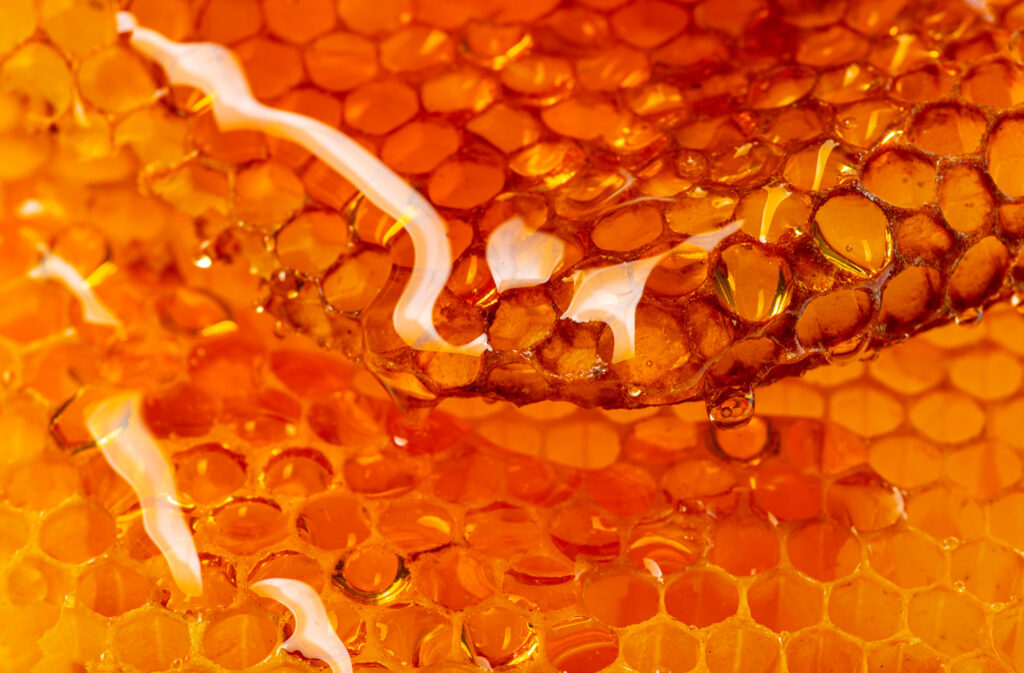
Many people believe that crystallized honey is spoiled or has expired. In reality, the opposite is true.
Crystallization is a completely natural physical phenomenon that demonstrates that honey maintains its characteristic composition.
Understanding this process helps us better appreciate a food made by bees and prevents us from discarding honey that is still perfectly safe to eat.
What is honey crystallization?
Honey is a supersaturated solution of natural sugars.
Over time, some of the glucose loses solubility and begins to form small crystals.
These crystals gradually spread throughout the jar, altering the honey’s texture, which can change from liquid to creamy or solid.
This is not fermentation or product spoilage.
Why do some honeys crystallize faster than others?
Each floral variety has a different composition.
Honeys with a higher glucose content, such as some rosemary or wildflower varieties, tend to crystallize more quickly.
Other honeys with a higher fructose content remain liquid for longer.
Factors such as storage temperature, the presence of small natural crystals, and water content also play a role.
Does temperature affect crystallization?
Yes. Crystallization usually accelerates at temperatures between approximately 10 and 15 °C (50-59 °F).
That’s why many honeys crystallize sooner during the colder months or when stored in cool places.
The refrigerator is not a good place to store honey, as it promotes crystallization without offering any preservation benefits.
Does crystallized honey lose its properties?
No. Crystallization primarily alters the honey’s texture.
The flavor, nutritional value, and overall characteristics remain virtually unchanged.
Crystallized honey is still a quality honey as long as it has been properly produced and stored.
How to reliquefy crystallized honey?
To restore a more fluid texture, you can place the jar in a warm water bath.
It’s best to stir gently from time to time and avoid high temperatures or sudden heating.
This way, the aromas and other natural characteristics of the honey are better preserved.
Common myths about crystallization
It’s false that all liquid honey is better or that crystallized honey is adulterated.
It’s also incorrect to think that crystallized honey cannot be consumed or that all varieties crystallize in the same way.
Each floral origin has a different composition and behavior.
Crystallization is a natural process
Crystallization is part of the natural cycle of honey.
Far from being a defect, it is a common sign of authenticity and that the product retains its original composition.
Understanding this phenomenon allows you to choose more wisely and enjoy honey as the bees produce it, respecting its nature and unique characteristics.