
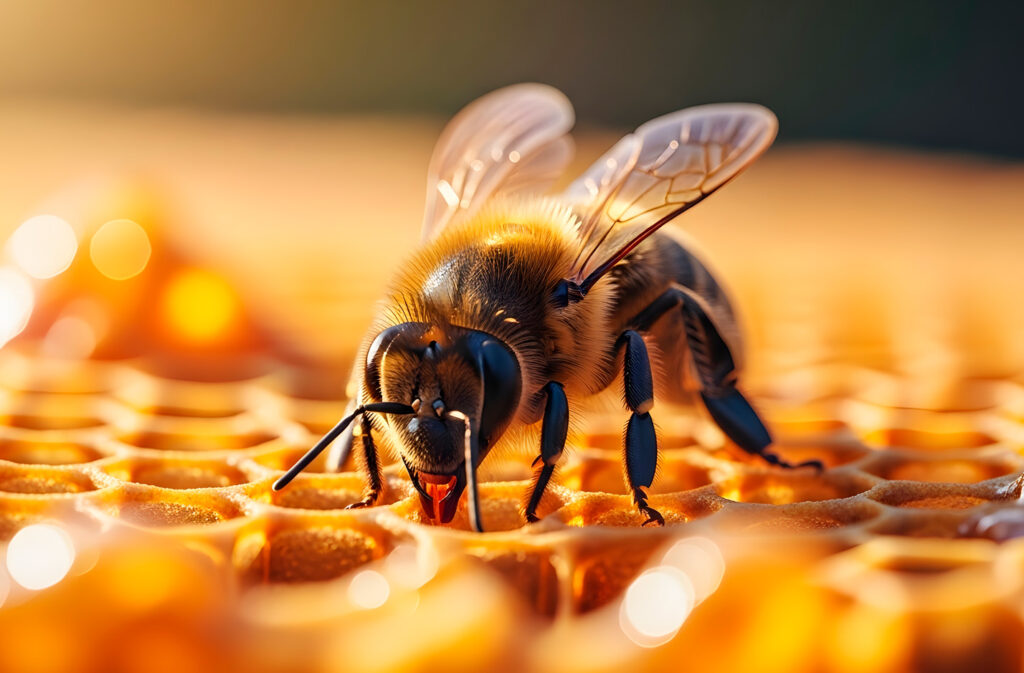
Each spoonful of honey is the result of thousands of flights and extraordinary collective work.
A single bee produces only a small amount of honey throughout its entire life, so each jar represents the coordinated effort of an entire colony.
Understanding this process allows us to appreciate even more this unique food created by nature.
1. The search for nectar
It all begins when foraging bees leave the hive in search of flowers.
Guided by scent, color, and the position of the sun, they visit hundreds of flowers during a single flight.
With their long tongues, they collect nectar, a sugar-rich liquid produced by plants to attract pollinating insects.
2. The journey back to the hive
The nectar is stored in a special organ called the honey stomach, which is separate from the digestive stomach.
During the return flight, natural enzymes begin to work, gradually transforming some of the sugars in the nectar and preparing the future food.
3. The relay within the hive
Upon returning, the bee delivers the nectar to other worker bees through an exchange known as trophallaxis.
Several bees collaborate in this process, enriching the nectar with new enzymes and progressively reducing its water content.
4. Honey Maturation
The worker bees deposit the liquid in the honeycomb cells.
Then they continuously ventilate the hive by beating their wings to promote water evaporation.
When the humidity reaches an appropriate level, the honey acquires its characteristic stability.
5. Sealing the honeycomb
Once mature, each cell is sealed with a thin layer of wax.
This capping protects the honey and allows it to be preserved for long periods inside the hive as a food reserve for the colony.
6. The beekeeper’s work
The beekeeper only harvests mature honeycombs.
After carefully removing the wax capping, the honey is extracted by centrifugation.
It is then filtered to remove small natural wax particles without altering its essential characteristics and packaged to preserve its qualities as much as possible.
How many flowers are needed to produce honey?
It is estimated that to produce one kilogram of honey, bees visit millions of flowers.
If all the flights made by the colony are added up, they travel a distance equivalent to several times around the Earth.
These figures help to understand the enormous effort behind each harvest.
The importance of bees
In addition to producing honey, bees play a fundamental role in the pollination of numerous plant species.
Thanks to their activity, bees promote the reproduction of wild plants and agricultural crops, contributing to biodiversity and food production.
From flower to jar
Honey is much more than a sweet treat. It is the result of a complex biological process, the coordinated work of thousands of bees, and the care of the beekeeper.
Each jar encapsulates the landscape, the blooms, and the effort of a colony that transforms flower nectar into one of nature’s most extraordinary foods.