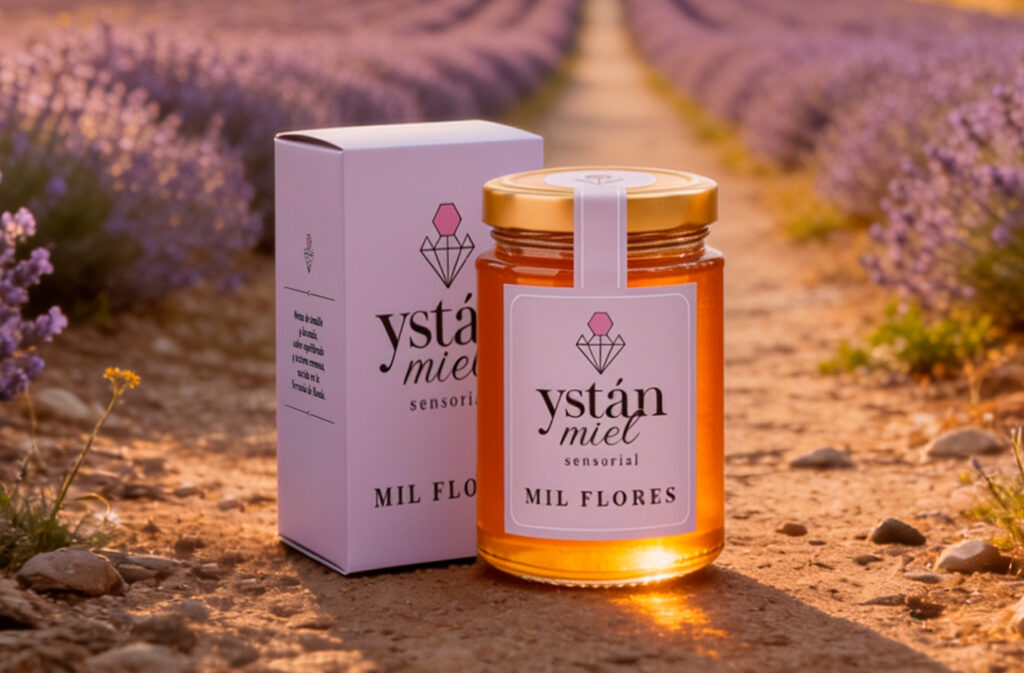
Wildflower honey is one of the best-known and most consumed varieties. Unlike monofloral honeys, it comes from the nectar of numerous plant species, resulting in a product full of nuances and with a personality that changes with each harvest.
What is wildflower honey?
It is obtained when bees collect nectar from different flowers found in the same area.
The final composition depends on biodiversity, climate, and the time of flowering, making each harvest unique.
Origin of wildflower honey
It can be produced in very different landscapes. In mountainous areas, wild species predominate, while in Mediterranean areas, aromatic plants, wildflowers, and native vegetation appear.
This diversity is precisely one of its greatest strengths.
Sensory characteristics
Its color can vary from light amber to darker shades. The aroma is complex and evolves according to the predominant bloom.
On the palate, it typically offers a balanced sweetness, with floral and herbaceous notes, and sometimes subtle hints of fruit.
Properties of wildflower honey
Like all natural honeys, it provides energy thanks to its fructose and glucose content.
It also contains enzymes, amino acids, minerals, antioxidants, and phenolic compounds, the presence of which depends on the plant species visited by the bees.
How to recognize good wildflower honey
It is important to check the origin, choose producers with traceability, and appreciate a clean and natural aroma.
Crystallization is not a defect, but a normal process that demonstrates the product’s naturalness.
Crystallization
Wildflower honey may crystallize sooner or later depending on the proportion of different honeys present in each harvest.
This change in texture does not alter its quality or properties.
Culinary uses
Its balanced composition makes it a very versatile honey. It’s ideal for breakfasts, toast, yogurt, fruit, tea, and baking.
It also pairs beautifully with soft cheeses and can be used to make vinaigrettes and other recipes.
How to store wildflower honey
It should be stored in a cool, dry place away from light. Refrigeration is not recommended.
If it crystallizes, you can restore a more fluid texture by gently warming it in a water bath.
A different honey with each harvest
Wildflower honey reflects the richness of each landscape and the work of the bees throughout the flowering season.
Its character changes with each harvest, making every jar a unique product. Choosing a quality wildflower honey means enjoying the natural diversity that each region offers.